Why the Bhagavata Purana Exists
The Problem of Accessibility
The Vedas were not meant for everyone. The Upanishads were not meant for everyone. The philosophical tradition of India's highest period was an elite tradition — transmitted through rigorous lineages, requiring years of preparation, in Sanskrit that ordinary people did not speak. This was not arrogance. It was precision. Certain forms of knowledge degrade when imprecisely transmitted.
The bhakti tradition — devotional love as the primary path — solved this problem. It recognized that most people will not achieve liberation through philosophical rigour, but that everyone can achieve it through love. Vyasa composed the Bhagavata Purana specifically as the vessel for this: the highest truth of Vedanta, encoded in stories that a grandmother could tell a child, that a farmer could carry in his memory, that a weaver could sing at her loom. The Bhagavata Purana was not a compromise. It was a delivery mechanism — the tradition choosing accessibility without sacrificing depth.
This decision — to encode truth in story — is why the tradition reached Detroit. Not because Detroit is unusual. Because story travels. The Vedas required a lineage. The Bhagavata Purana required a grandmother. Every household in the Braj tradition had one.
The Transmission Chain
From Mathura to Michigan
The chain runs like this: Bhagavata Purana to the bhakti saint-poets — Mirabai in Rajasthan, Surdas in Braj, Tulsidas in Varanasi, Chaitanya Mahaprabhu in Bengal — whose songs made the theological content emotionally immediate and memorizable. From the saint-poets to the acharya lineages — Ramanuja, Madhva, Vallabha — who provided the philosophical framework that prevented the devotional tradition from becoming sentiment without substance. From the acharyas to the oral tradition maintained by grandmothers across generations who had no formal education but who knew, by heart, every story in the Bhagavata Purana and what each one meant.
And then, in 1965: A.C. Bhaktivedanta Swami Prabhupada arrived in New York with $7, a trunk of books, and the commission from his teacher to spread Krishna consciousness in the English-speaking world. He was 69 years old. He sat in Tompkins Square Park in Manhattan and played the mridanga drum and chanted. Within a decade, ISKCON had established temples across America, Europe, and Asia. The tradition that began in Mathura 5,000 years ago reached Michigan within living memory — carried by one man with seven dollars and the entirety of what he had received.
The ISKCON Krishna Balaram Mandir in Vrindavan, built in 1975, is the formal link in that chain that you can visit. Stand in that temple and you are standing at the point where the transmission from Vrindavan to the world was most directly institutionalized. The bhajan that will be sung there this morning was sung in the same form in Vrindavan five centuries ago.
A novel is built to move you. The Bhagavata Purana is built to transform you. Both matter. They are not interchangeable.
The Diaspora's Responsibility
Knowing the Difference
Modern novels about Krishna are often compelling. Some are written with genuine affection for the tradition. Some are written by people with deep knowledge of it. They find readers among diaspora Hindus who did not grow up with the Bhagavata Purana in their homes and who receive the novel as their first real encounter with Krishna's story.
This is the problem that the Bhagavata Purana itself predicted and tried to prevent. The Purana was composed precisely because Vyasa understood that without a widely accessible version of the tradition, the tradition would be replaced — not by enemies, but by well-meaning storytellers filling a vacuum with something more immediately graspable. The vacuum is always filled. The only question is by what.
The diaspora community has a specific responsibility here — not to be hostile to modern retellings, but to know the original well enough to recognize what is and is not in it. To have read the Bhagavata Purana, or at least the 10th Book, or at least a reliable commentary on it. To know that the Raas Leela is in chapter 29, that the commentarial tradition on it is 1,000 years old and unanimous on its allegorical meaning, that the romantic interpretation is not ancient wisdom recovered but recent arrival. To know the difference between Radha as a theological concept and Radha as a romance character. To know who Meera Bai actually was.
This is not about purity or orthodoxy. It is about having the knowledge that allows you to choose consciously — to read a modern retelling as a novel, appreciate it as a novel, and not mistake it for the tradition. The diaspora that knows its source can engage with everything downstream of it without losing its bearings. The diaspora that has only the downstream has already lost the source.
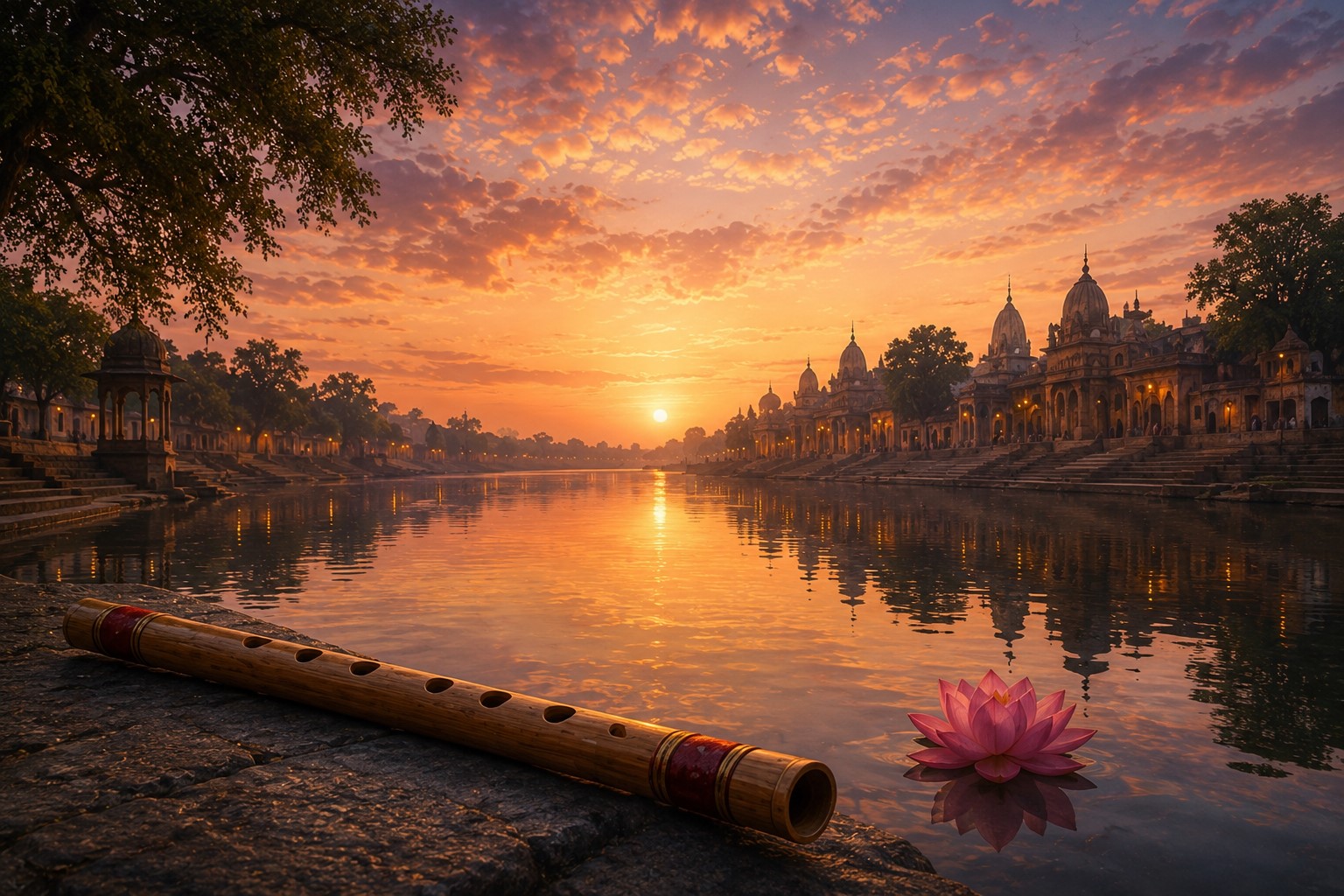
The Yamuna at dusk — the flute on the stone, the lotus on the water, the temples still standing. The tradition is still here. The only question is whether we are ready to receive it.
यदा यदा हि धर्मस्य ग्लानिर्भवति भारत ।
अभ्युत्थानमधर्मस्य तदात्मानं सृजाम्यहम् ॥
परित्राणाय साधूनां विनाशाय च दुष्कृताम् ।
धर्मसंस्थापनार्थाय सम्भवामि युगे युगे ॥
Yadā yadā hi dharmasya glānir bhavati Bhārata / abhyutthānam adharmasya tadātmānaṃ sṛjāmy aham / paritrāṇāya sādhūnāṃ vināśāya ca duṣkṛtām / dharma-sansthāpanārthāya sambhavāmi yuge yuge
Whenever dharma declines and adharma rises, O Bharata — I manifest myself. To protect the righteous, to destroy evil, to restore dharma — I come, age after age.
Bhagavad Gita 4.7–4.8
You have just read about Development — what was destroyed and what is being restored. About History — who Krishna was and what his life encoded. About Culture — what the tradition actually says, and what has been substituted for it. About Food — how offering differs from cuisine. About Community — how the temples tell a story that can be walked. And now Diaspora — how the tradition traveled and what the traveler carries.
Read this shloka now. You understand it differently than you did before you started. That is what the entire issue was reaching toward. The promise in those two verses is not comfort. It is continuity. The tradition does not require our protection. It requires our attention. It will come, as it always has, age after age. What we provide is the reception — the community that is ready when it arrives, that recognizes it, that does not mistake the substitute for the original.
Mathura and Vrindavan are still there. The Yamuna is still flowing. The forest of Vrindavan has not moved. The hill of Govardhan is still being walked. The curtain at Banke Bihari still opens and closes, every few seconds, the divine revealing itself in glimpses, on its own terms. The flute is still on the stone at the river's edge. Come when you are ready to hear it.