Resurrection of Dharma's Capital
A City Remembering What It Always Was
Ayodhya is not being reinvented. It is being remembered. For centuries, the city existed in a strange condition—physically present, spiritually alive, yet incomplete in the eyes of millions who carried the memory of Ram Janmabhoomi across generations. Kingdoms changed. Empires rose and fell. Political realities shifted. But the name "Ayodhya" never faded from Hindu consciousness. It survived in bhajans sung inside homes, in Ramayana stories told by grandparents, in temple rituals, in pilgrimages, and in the quiet certainty that one day Rama would again be worshipped openly at the place Indians had always remembered as his birthplace.
That's why January 22, 2024 felt different to so many people across the world. When the consecration ceremony installed Ram Lalla in the new temple, millions experienced it not as the inauguration of something new, but as the continuation of something ancient that had finally returned to visible form. For older generations especially, there was an emotion difficult to fully explain—the feeling of witnessing in their own lifetime something their ancestors longed for but never saw themselves.
The transformation unfolding here is not just modernization. It is civilizational restoration.
Infrastructure as Sacred Service
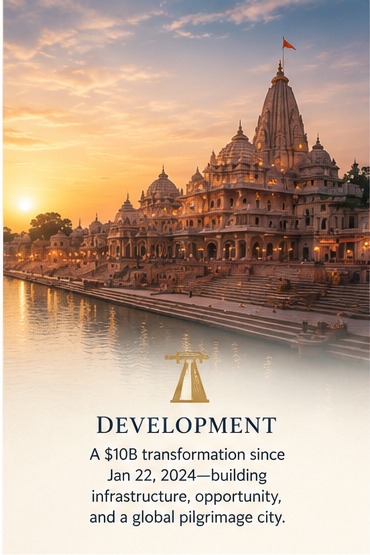
Over $10 billion in projects are now reshaping Ayodhya. New roads connect pilgrimage routes. Ghats along the Sarayu have been restored and illuminated. Public spaces have been redesigned to handle millions of visitors each year. The Maharishi Valmiki International Airport now welcomes pilgrims directly from across India and the world. Ram Path, Bhakti Path, Janmabhoomi Path, and the Ram Van Gaman Marg have transformed not just mobility within Ayodhya, but the entire experience of pilgrimage itself.
Every project seems designed around a simple principle: remove obstacles between the devotee and the divine. Roads are wider so elderly pilgrims can walk comfortably. Pathways are cleaner so families can move safely during festivals. The airport reduces exhausting travel for devotees arriving from abroad. Riverfront restoration allows the Sarayu to become a central spiritual experience again rather than a neglected edge of the city.
The Ram Path stretches through Ayodhya not simply as a road, but as a ceremonial movement toward the temple itself. The Bharat Path honors Bharat, who refused to sit on the throne during Rama's exile and instead ruled as caretaker in Rama's name. Even the names of roads remind visitors that Ayodhya was never imagined merely as a political capital, but as a moral and spiritual one.
Then there's the Ram Van Gaman Marg—the pilgrimage route tracing Rama's journey into exile toward Chitrakoot. Thousands now walk portions of this route not as tourists, but as seekers trying to understand something deeper within the Ramayana. Rama doesn't embrace exile because it's easy. He embraces it because righteousness sometimes demands sacrifice even from those who least deserve suffering. To walk that path, even briefly, is to experience the Ramayana not as story, but as inward reflection.
Every project seems designed around a simple principle: remove obstacles between the devotee and the divine.
A Civilizational Scale
The scale of Ayodhya's resurgence becomes easier to understand when compared to other major pilgrimage centers. Tirupati traditionally receives 25 to 35 million pilgrims annually. Vaishno Devi welcomes about 8 to 10 million. Kashi Vishwanath, after its corridor redevelopment, saw visitor numbers surge beyond 100 million annual visits. Ayodhya is now entering that same scale—in the months following the consecration, estimates suggest over 100 million devotees had already visited the city.
Many pilgrims arrive from London, Toronto, Singapore, Sydney, or Detroit carrying stories heard throughout childhood from parents and grandparents who never imagined they would one day stand before a restored Ram Mandir. For countless diaspora families, Ayodhya was never just geography. It was inheritance.
Restaurants have increased from roughly 200 a few years ago to nearly 2,000 today. Rickshaws have surged from around 500 to nearly 17,000. More than 1,100 homestays now operate where virtually none existed before. Small shopkeepers who once earned about $5–6 per day often now report daily earnings between $30 and $95 during peak pilgrimage periods. Tourism-driven revenue is projected to exceed $1.2 billion annually.
But for many local residents, prosperity is experienced less as commercial opportunity and more as participation in something sacred. Artisans carving sandstone for temple structures describe their work not as employment, but as seva. Shopkeepers selling prasad speak of devotion before revenue. The city's transformation keeps returning to the same language: Ayodhya is remembering what it always was.
A Different Model
In the Western imagination, modernization often requires religion to retreat into the private sphere. Sacredness survives, but separated from public life, economics, and governance. Ayodhya presents a different model. Here, development doesn't attempt to replace the sacred. It organizes itself around it.
For nearly five centuries, generations protected the memory of Ram Janmabhoomi without certainty they would ever see its restoration. They preserved it through prayer, ritual, pilgrimage, storytelling, and faith carried quietly across the years. The present generation inherited the blessing of witnessing what their ancestors could only imagine. Civilizations survive not only through military power, political institutions, or economic strength. They survive because people refuse to forget what they hold sacred.