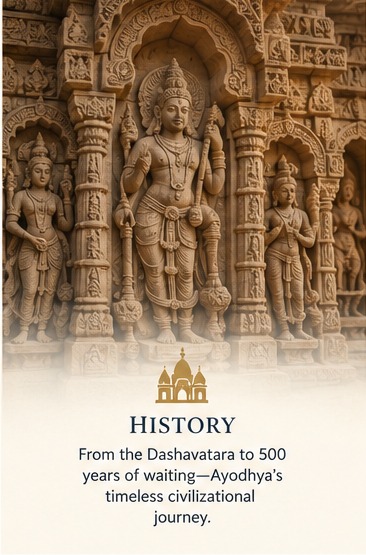
The Solar Dynasty & Ten Avatars
When Vishnu Descends to Restore Dharma
To understand Ayodhya's place in history, you need to understand the Dashavatara—the ten avatars through which Vishnu descends whenever dharma declines. Rama was the seventh. Before him came Matsya the fish, Kurma the tortoise, Varaha the boar, Narasimha the man-lion, Vamana the dwarf, and Parashurama the warrior-sage. Each arrived at a moment of civilizational crisis. Each restored balance through a different expression of divine power.
Rama's expression was governance. He came not to fight demons alone, but to demonstrate what a king looked like when righteousness, not ambition, drove every decision. He chose exile over confrontation. He honored duty over comfort. He demonstrated that power existed to serve dharma, not to accumulate itself. After Rama came Krishna, who revealed the Bhagavad Gita on the battlefield of Kurukshetra. Then Buddha, who turned toward compassion and detachment. And still to come is Kalki—the tenth avatar, prophesied to arrive at the end of this age, closing the cosmic cycle that Rama's birth once marked.
The Ikshvaku Dynasty
A Lineage Built to Serve Dharma
Rama was born into the Ikshvaku dynasty, the Solar lineage descended from Ikshvaku, son of Manu—the first human and lawgiver in Hindu cosmology. For millennia before Rama, Ikshvaku kings ruled from Ayodhya. Their kingdom was Kosala. Their mandate was simple: uphold truth, defend the defenseless, honor the sacred. Kingship in this tradition was not entitlement. It was obligation. The throne existed to serve the people, and the people existed to uphold dharma.
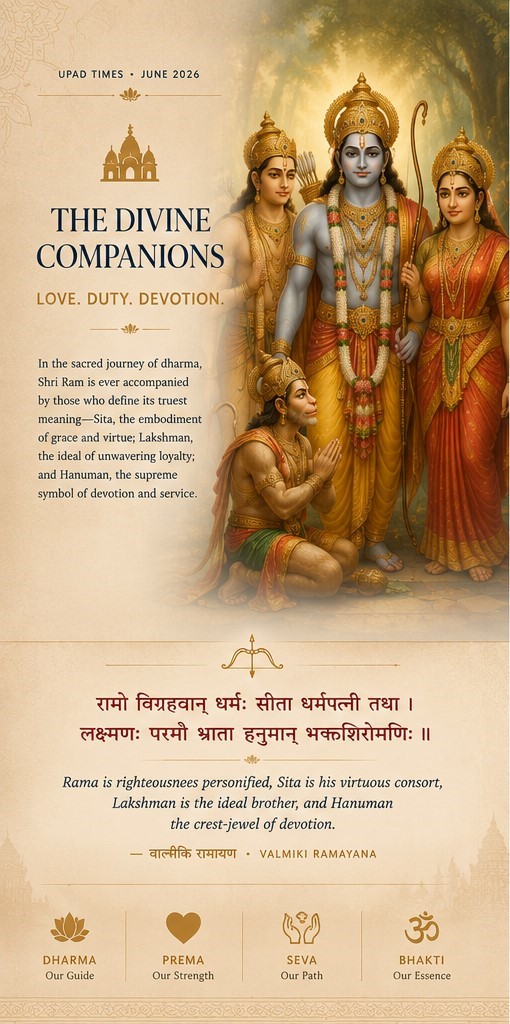
The Divine Companions · Love. Duty. Devotion.
It was within this lineage that the women of Rama's story played roles that history has sometimes misread. Sita was no rescued damsel—she was dharmic equal, choosing exile over comfort, walking through fire not in doubt of herself but because dharma demanded public witness. Kausalya raised a son who chose duty over throne. Kaikeyi, often cast as villain, was the mechanism the cosmos needed—without her boon, Rama never enters the forest, never confronts Ravana, never fulfills the purpose that justified his incarnation. And Sumitra taught Lakshmana the dharma of selfless support: that strength also shows up in standing beside, in enabling another's purpose to manifest.
Kingship in the Ikshvaku tradition was not entitlement. It was obligation — the throne existed to serve the people, and the people existed to uphold dharma.
Five Hundred Years of Memory
When Remembering Was Resistance
From 1528, when the Babri Masjid was built on the site tradition marked as Rama's birthplace, until January 22, 2024, when the Ram Mandir was consecrated, Ayodhya endured a 500-year test of collective memory. Empires rose and fell. Colonial powers redrew maps. Modernity dismissed mythology. Yet through five centuries, millions of Hindus maintained that this specific location—not a general area, not a symbolic site, but this exact geography—was where Rama was born.
They preserved the knowledge through oral tradition when written records were destroyed, through pilgrimage when temples were demolished, through faith when evidence was erased. Priests still performed puja in the disputed structure's outer courtyard. Artisans still carved Rama's image into stone. Grandmothers still taught children the Ramayana before the alphabet. When legal processes finally aligned with the claim—when excavations revealed temple foundations beneath the disputed structure, when the Supreme Court ruled the land be returned—it wasn't victory over opponents. It was 500 years of memory receiving its long-overdue acknowledgment.
Ayodhya teaches that civilizational memory is its own form of endurance. The city that witnessed Rama's birth, coronation, and return from exile carried that witness across eras when remembering was dangerous. What is true does not disappear when denied. It waits. And eventually, it rises.